I believe that the journey is just as important as the destination, as is reflected in one of my favorite quotes by author J.R.R. Tolkein. Sit back and enjoy as I wander through life, keeping in mind that Not All Who Wander Are Lost!

Showing posts with label love. Show all posts

Saturday, September 12, 2009

Quick-fire movie review: (500) days of Summer

This review is long overdue to say the least - I saw (500) Days of Summer before I went to Canada for my cousin's wedding in mid-August... but it's the kind of film that was so good, I feel obliged to review it, even if it has been a while. Since time has elapsed, I'm going to focus on the parts of this film that have stayed with me for over a month, not only telling you why it was good, but why it was memorable.

Honestly, this is probably one of the best films of the year, which I say knowing that the "movie season" (which in my mind leads up to the Oscars in February) is only about half over. It was enjoyable, well-crafted, thoughtful, intelligent, well-acted, cinematically creative, funny, sweet... I could list adjectives for another paragraph. The premise is simple, as the poster says: "This is not a love story, This is a story about love." In other words, as per the beginning of the film itself, "This is a story of boy meets girl, but you should know up front, this is not a love story."

(500) Days of Summer takes everything you think you know about the rom com/chick flick/girly film and turns it on its head. It is from the boys perspective. Depending on how you look at it, it doesn't necessarily have a "happy" ending. It is optimistic and at the same time, completely realistic. I saw it with an extremely diverse group of people - male, female, different ages and preferences - and everyone liked it. How many times can you say that, honestly?

A few moments from the film stand out vividly in my mind, and perhaps, by describing these and the effect they had on me, I will be able to communicate this film's beauty and power. Of course, if you haven't seen it and don't want to know any of this before you do see it, feel free to stop reading any time.

Moment #1:
"She only loved two things. The first was her long dark hair. The second was how easily she could cut it off and feel nothing."
First of all, I love this writing. But even more than that, this simple line illustrates the power of characterization that these filmmakers have. A few sentences of narration, right from the beginning, of odd anecdotal information, and we know exactly who we're dealing with. Furthermore, this line shows one thing I found very unique and powerful about the film, the characterization of "the girl" - Summer. This is not a typical chick flick chick. She does not melt at the sight of her soulmate, but RUNS from commitment. Sound familiar? I'm only describing every guy to ever grace the silver screen in a romantic comedy. The role reversal was one of this film's most powerful weapons, and quite frankly, it was refreshing.

Moment #2:
Expectations versus Reality
A very important sequence in the film is when our main character is invited to Summer's house for a party after not seeing her for some time. In filming the time leading up and through the party, the camera changes to a split-screen, marked on one side "Expectations" and the other "Reality." Before our very eyes, two scenes are acted out simultaneously, the way that Tom hopes things will go with Summer (Hint: she's thrilled to see him and shows it) and the way things actually go (Not the same). Wow. I mean, I've never seen such purely psychological filmmaking. It might sound odd, but even though it's only in this one scene, the technique totally works. It grabs our attention. It shows us what we do with our own minds. Just wow.

Moment #3:
"I'm the hero of this story, I don't need to be saved!"
This line comes from one of the songs on the film's soundtrack, "Hero," by Regina Spektor (who's voice I am COMPLETELY in love with). Usually, I don't like songs that are on a film's soundtrack. I am enamored with musical scores, but unless the song is iconic (in which case it's usually overused), it just doesn't draw my attention. The (500) Days of Summer soundtrack is a completely different matter. Almost all of the songs were vaguely familiar, but not well-known. They fit my mood, my personality, and most importantly, the scene they were placed in. After downloading it, a few songs in particular have caught my fancy, most notably the two by Spektor, one by Feist (of 1234/Apple ad fame), and haunting melody by France first lady Carla Bruni. The line I quoted comes from my favorite song, and in so many ways, summarizes what this film is about. As I've already said, this movie turns Hollywood on its head. Boy meets girl, but girl and boy don't make it together. The story doesn't end at "love at first sight." Gah, I just love the lyric and everything it represents.

Moment #4:
(MAJOR SPOILER)
Autumn
A great movie needs a great ending, and boy did this one deliver. If you know the film, you know what I'm talking about, the moment where it all pays off: Autumn, a quirky, unexpected and yet *perfect* way to finish. I don't have much to say about this, but to pay homage to it. These filmmakers sure know what they're doing.


Friday, April 24, 2009

Lighthearded Misunderstandings

I wanted to take a momentary break from studying today (I'm home for a glorious five day weekend) to review a book I finished reading last weekend and greatly enjoyed. The book I'm thinking of is Northanger Abbey, one of Jane Austen's shorter, lighter, and lesser-known works. I decided to read it now - of all times - because it is the current topic of discussion in the Austen group I participate in every Sunday night. I'm sure my opinion of it will morph and change as we discuss it - in fact, I think it already has since the time of our first meeting - but I still wanted to share a few thoughts.

Since you probably don't know unless you've read it, Northanger Abbey tells the story of the young and innocent Catherine Morland who is invited to Bath by her family's friends, the Allens. In Bath, Catherine meets the Thorpe family - befriending the girl of her same age, Isabella. She also meets a young Mr. Henry Tilney, later befriending Tilney and his sister Eleanor. The plot heats up when General Tilney, Henry's father, invites Catherine to stay with them at their Abbey home - for a reason that causes much distress and confusion by the end of the novel. Because Catherine had been reading the type of Gothic romances that were oh-so common in Austen's era, she expects (but does not find) a dark and ancient home, full of fantastical mystery. The novel was one of the first Austen wrote, but also one of the last that was published after her death.

The character Catherine is a tricky one to interpret. She's not as easily likable as Elizabeth Bennet, nor easy to immediately dislike like Fanny Price, and still not as flawed as Emma. In many ways, her naivete was what really frustrated me - the same dramatic irony that led me to call the story's end three chapters end annoyed me beyond end when the story's heroine couldn't seem to understand what was going on. That said, being a simpleton is not the greatest fault and, overall, I liked the heroine and the story.

There were two particular passages in the novel that I just knew I had to share as soon as I read them. They're in so many ways the epitome of Austen - funny, witty, and full of voice and social commentary. Northanger Abbey has a much stronger authorial voice than the other novels - it's pervasive throughout almost the entire novel, compared to simple passages here and there like Pride and Prejudice. Perhaps this is because Austen was less practiced as an author and had not yet found her true style, or maybe it's just how she wanted to write this story, but because of the shortness and sweetness of the novel, it works.

Any-who, there is one passage when the reader learns that - gasp - Catherine enjoys reading novels. I'm not sure what it was that girls during this time were supposed to be reading, but it's clear that Austen didn't agree with the societal disdain for the type of writing she was endeavoring to create:
[Catherine and Isabella would] shut themselves up, to read novels together. Yes, novels; - for I will not adopt that ungenerous and impolitic custom so common with novel writers, of degrading by their contemptuous censure the very performances of which they are themselves adding - joining with their greatest enemies in bestowing the harshest epithets on such works, and scarcely ever permitting them to be read by their own heroine, who, if she accidentally takes up a novel, is sure to turn over its insipid pages with disgust. Alas! if the heroine of our novel be not patronized by the heroine of another, from whom can she expect protection and regard? I cannot approve of it. Let us leave it to the Reviewers to abuse such effusions of fancy at their leisure and over every new novel to talk in threadbare strains of the trash with which the press now groans.
Now, at the risk of this turning into an English essay, I do want to talk about this passage! It's hard to explain why I'm so drawn to it, but reading these few sentences absolutely makes me grin. It's SO Austen. Her voice - though part of a story, wrapped up in a character - is so strong. You feel as if she's in the room with you, reading passages like these. You can hear her disdain for hypocritical authors dripping from each word. The power of writing like this - to come alive before you - is phenomenal... and all done in a time when women weren't even supposed to be writing at all!

One more, and then I promise I'll go back to my usual college chit-chat, my professions of Harry Potter love, and my blathering about movies. As the story progresses, we see the usual rituals that mark Austen's novels and bring her time period to life. The societal traditions, the "dos and do NOTs" of being proper, the balls, dances, and propriety. Northanger Abbey has a particularly interesting take on all this as Austen focuses her lens on Bath - a bit of a more public and social setting than the usual small villages of Meryfield or Highbury. At once of the dances, when Mr. Tilney and Miss Morland finally make it to dancing, Henry begins to compare dancing and marriage, exclaiming how very alike they are:
"We have entered into a contract of mutual agreeableness for the space of an evening, and all our agreeableness belong solely to each other for that time. Nobody can fasten themselves on the notice of one, without injuring the rights of the other. I consider a country-dance as an emblem of marriage. Fidelity and complaisance are the principal duties of both; and those men who do not chuse to dance or marry themselves, have no business with the partners or wives of their neighbours."
[...]
"Taken in that light certainly, their resemblance is not striking; but I think I could place them in such a view. - You will allow, that in both, man has the advantage of choice, woman only the power of refusal; that in both, it is an engagement between a man and woman, formed for the advantage of each; and that when once entered into, they belong exclusively to each other till the moment of its dissolution; that it is their duty, each to endeavor to give the other no cause for wishing that he or she had bestowed themselves elsewhere, and their best interest to keep their own imaginations from wandering towards the perfections of their neighbors, or fancying that they should have been better off with anyone else."
Okay, if talk of dancing and marriage made you cringe away from the entry, that's fine. In fact, you probably didn't even make it past the mention of Austen at the beginning, but I simply had to shout out to the world what a wonderful bit of writing this is. Did you notice that the second part of the quote is almost entirely ONE sentence? Seriously.

But what gets me most about this is the difference between this society and ours. Theirs, rules meant something. None of this "the government says we don't use torture, but lookie here, I guess we do" back-handedness. (Okay, there was some back-handedness in Austen's time, but it was different). There was a basic morality - something that could unite even things as dissimilar as dancing and marriage - that protected everyone from each other and kept the wheels on the bus going round and round.

I've often lamented this tradition of dance dying out - and I still think it's a phenomenal tradition, but more importantly, I like the base principle that kept this society together. Even young people - I believe Catherine is still a teen in this novel - is raised with a basic idea of what's right and wrong. I think this is fading from our society now; being mixed up by warring factions of religious, political, or ethnic beliefs. I think it's time we returned to a simpler time - yes, in many ways this rigidly governed society was simpler - when a dance could be compared to marriage, when people would have a "contract of mutual agreeableness" and be happy with each other for an evening.

Anyway, I found this a very interesting Austen novel - quite different from the other "high-profile" ones I've been reading so far. I'd best get back to studying - IB and AP tests begin in a little over a week, and I've got knowledge to cram into my brain. Cheers! <3

Saturday, April 11, 2009

It's Good to Be King

I wanted to take a moment to go back to the usual topic I choose to write about... entertainment, in whatever form it tends to enter my life in. Right now, the media form of choice that's populating my life is TV, as I haven't come across any stupendous movies recently, and, though I still mean to talk about Life of Pi, something else is simply on my mind MORE. (Maybe Pi tomorrow?)

The last few nights, I've been digging into the second season of The Tudors, the Showtime masterpiece that tells the tale of grand ol' Henry VIII. Of course, as soon as my dad hits the tarmac to fly out to North Caroline, my mom and I jumped back into this fabulous (and slightly girl-oriented) show. Though it's been quite some time since I saw the first season, it didn't take much to get me hooked again.

Now, I hardly need to explain, I'm guessing, but The Tudors tells the tale of Henry VIII. More specifically, it is currently focusing on his relationship with Anne Boleyn, and the upheaval of the Church of England that resulted from his efforts to annul his first marriage.

(*I'm guessing I don't have to warn about spoilers since this is all historical, but I will be talking about the events of the first two seasons in this post, FYI.*)

In our current season, so far, Henry succeeded in naming himself the head of the Church of England - over the Pope and the church in Rome. He has officially declared his marriage to Catherine of Aragon null and void (though she will not accept this), banished Catherine to a dingy and cold castle, and finally married Anne, making her queen. As the season has progressed, Anne became pregnant, but failed to give birth to a son, instead bringing the future Queen Elizabeth into the world. Things are becoming strained between Henry and Anne and he is beginning to turn to mistresses again. Surely (as history dictates), it is only a matter of time before he turns to a more lasting relationship, in the form of Jane Seymore. On a more political note, Henry has demanded that everyone in England swear an oath that states they accept Anne as his wife and their queen, and that they recognize him as head of the church. Notably, Henry's good friend Sir Thomas Moore refused this oath (the second part, in particular), and was killed for this.

So, that's where we stand. The show has been faulted on and off for historical inaccuraces, but overall, it gets the picture across. This season has some new faces - with Cardinal Wolsey's large role gone, someone(s) had to fill the vaccuum. So far, I'm intrigued by the characters of Oliver Cromwell, Bishop Cranmar, and the poet (and former lover to Anne) Wyatt. Oh, and I am absolutely loving Peter O'Toole's stint as Pope. Now, on a more opinion-y note, I just wnat to start by saying that I absolutely LOVE this period of history, and have for many years. I have always been fascinated by Queen Elizabeth and, indirectly, Henry VIII, though I had never learned quite so much in detail about the political and religious sides of the story. This show does an excellent job balancing the sexy intrigue and court politics with the power plays and religious upheaval of the time.

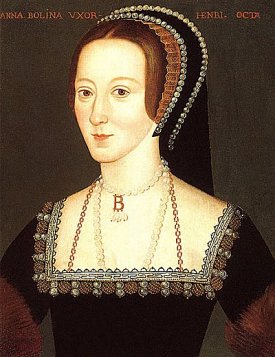
In the same way I loved Cate Blanchett's Queen Elizabeth films and Helen Mirren's Queen Elizabeth miniseries, I love to see this period come to life. Though, chronologically, 500 years back in history is not that long (compared to, say, cave men), it is a very distant time from our own advanced technological age. It's always been hard to imagine people like King Henry and Anne Boleyn as real because the images we have of them are so odd, and thus, they are hard to imagineas real. Paintings like this (of Anne) or this (of Henry) make it hard to imagine real people, though evolutionarily, 500 years would not have made much of a difference from us and they probably would have looked like someone who got lost at a Renaissance Fair. As I was discussing with my mom last night, the artists and art during this time did not capture what a person really looked like, so I value the ability of The Tudors to bring it all to life.

It's easy to imagine that our world of financial collapse, corrupt CEOs, political charisma is complex and dramatic, but, really, consider England during the 1500's. The king had near absolute power (Parliament was really a puppet group), he married and divorced (or beheaded) SIX women (gasp!), war with France or Spain was a near constant threat, and a man's conscience was one of the strongest powers in the world. Mistresses were accepted, if not expected, and women were most often seen as pawns... political bargaining chips, if you will. Dress and costumes were elaborate in courts - jewels adorned nearly everyone, and dances, customs, and manners were complex beyond imagining. 500 years may not be that far back in our Earth's past, but from my point of view, it's a world away.

Also reviewed at Sazze.com: