I believe that the journey is just as important as the destination, as is reflected in one of my favorite quotes by author J.R.R. Tolkein. Sit back and enjoy as I wander through life, keeping in mind that Not All Who Wander Are Lost!

Showing posts with label interesting. Show all posts

Sunday, April 19, 2009

YOUR Planet?!?

This Friday's movie night brought a vision of the planet's destruction - not by nuclear means, nor by global warming, but by aliens. As the second end-of-the-world AND alien-type movie I had seen recently (Knowing, being the first), my mind was busy with comparisons. Of course, the films are very different - one being a scattered mix of genres with few goals and little morals and the other being the remake of a campy 1950's flick... but, regardless, even without the similarities that did exist, I found The Day the Earth Stood Still to be a far better movie.

The movie centers around a scientist (played by Jennifer Connolly), who is dragged off in the middle of the night by government agents. She arrives at a Fort something-or-other, where she is put in a briefing room with lots of other scientists, and told of the fast approach of an Earth-destroying asteroid of some sort. They are given 1 hour as a countdown, and Manhattan as a target. While they fly out to the city, bracing for impact, nothing hits, until they start to see a glowing orb flying towards them, slowing down. The orb, a planet-like object, that seems to be roughly the size of a skyscraper, lands in Central park. Out of it comes - you guessed it - Alien Keanu Reeves. Long story short, Reeves has come to A) attempt to talk to us humans and B) judge if we (as a species) are worthy of remaining on the planet. He decides we aren't, and begins to initiate D-Day Armageddon. Now, I won't go much further than that in the off chance that you decide to actually see this movie - which I more or less recommend.

A few things struck me about this movie. First off, it was comfortable in its own skin. It knew it was an alien movie, and it didn't try to hide that fact. Sure, at some points, they took themselves too seriously (such as when Connolly's character emphatically states "Well, he must have had another body before he came to Earth.") But, more or less, they didn't try to hide that they were dealing with aliens invading and destroying the human race. In all, it was rather cool to have such a campy story done with such AWESOME CGI. I mean, though I haven't seen the 1950 version of the film, I can imagine how corny it would have been - strings still attached to the UFO, and all that. But to have something that requires such suspension of reality done in a way that actually makes it seem real... well, that just shows you how far filmmaking techniques have come in recent years.

Next off, it's interesting to consider WHY this film was made - both in its original day and age, and now. The basic premise of the destruction of the human race is that the Earth is a very valuable and fragile planet - one of the few (or only) in the universe that can support complex life forms. And yet, the human race has become so destructive that it doesn't deserve to remain in control of Earth. Thus, said alien civilization steps in and removes the parasitic humans. (I'm getting Matrix undertones, here, but more on that in a minute). I'm not sure if the 1950's version of the movie was the original time it was written, but if so, let's take a moment to consider history at the time. Nuclear destruction was on the forefront of everyone's minds and - with the Cold War really getting going - the destructive capabilities of humans were, indeed, starting to feel quite fearsome. Fastforward to the 21st century... mutual destruction is in the back of our minds, but not an open threat. Instead, global warming is hitting us at every angle. Worrysome weather, fearsome planetary changes... are we finally seeing the fruits of our destructive capabilities? In all, I'm surprised this movie got panned so much by critics and viewers because, though it doesn't have a driven plot with wit and twists, as we may look for in the creme-of-the-crop kind of films, it is EXTREMELY resonant for the day and age we are living in.

This said, since so many people did NOT see this film, I think it's important to reinforce the message it bore - for it's an important one to remember. The movie stressed that humans needed to CHANGE if we were to keep our planet and our lives. However, as John Cleese's character said so clearly, it is often on the brink of destruction that the full capacity for change is realized. I agree with this in many ways. But, in the world we're living it, what's the brink? Is it when the Hurricanes get so bad that they wipe out entire cities? When fires rage for weeks, taking homes and burning forests? When the very ozone layer we depend on to continue living starts disappearing? Because it's starting to look like we've hit that brink to me. So, in all, I thought this was an admirable film. It bore an important idea that I think we need to continue hitting people over the head with. It's a pity it got so little attention because I thought it was an overall fun ride (with cool CGI), and with a solid core idea.

Just for one last moment, I do have to comment on Keanu Reeves. As Craig Ferguson (who my mom and I watch a lot) is often pointing out, Keanu doesn't do much in the way of acting... In fact, between this film and his other famous roles - Speed and The Matrix, I'm not sure he does much more than look solemnly at the camera/villain/love interest for the entire movie.


<-- Keanu Reeves as Klaatu in The Day the Earth Stood Still and Neo in The Matrix.


That said, he worked in this role. He was an alien who was sent to destroy an entire species, only to have his eyes opened by the compassion that humans can show. Did he need to act much for that? Probably not.

Sunday, March 29, 2009

Forgetting "Knowing"

***FYI, mild spoilers in here because it was the only way I could talk about this film. Don't read if you don't want to know. I don't give away everything, but a few tidbits of info.***

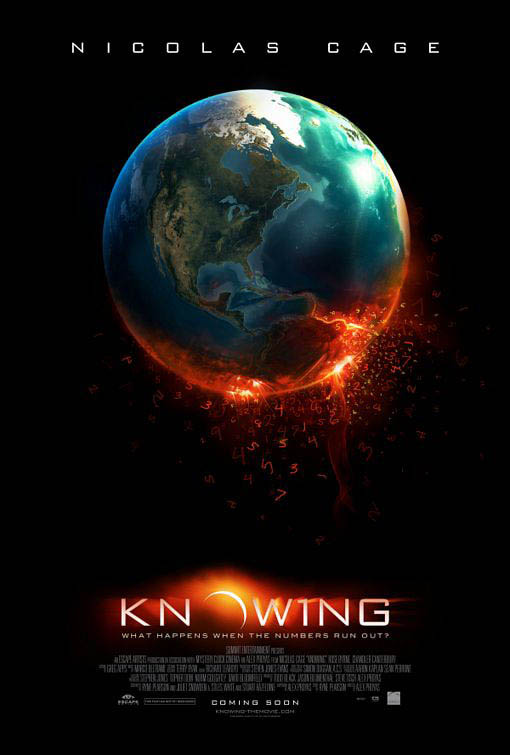
Yesterday afternoon, I topped off my spring break with one more jaunt to the theater. This time it was to see last weekend's box office hit Knowing, which stars Nicolas Cage. Now, if you read this blog or know me in any capacity, you'll know that I have a hard time saying that I didn't like something. Usually, I find enough nuggets of goodness (parts that I liked) to more or less enjoy a film (or book or experience... etc.). Not so with this film. I'm not going to say I hated it - because that isn't strictly true. But I wasn't a huge fan.

Let me start by saying what I did like so I don't just rip it apart all at once. First of all, I really do adore Nicolas Cage. He can do no wrong in my eyes. His presence on the screen made the film more or less workable. Second, I applaud the writers for the basic premise of the film - the idea of a sheet filled with numbers coming out of a time capsule, and having these numbers spell out all the natural disasters, etc etc... That is cool. Also, I like some of the ideas presented in the film. The presentation of science versus religion, determinism versus randomness, of the inevitability of our planet's destruction... those are a good set of ideas to build a film around. Particularly the last one. We're so worried about mutual destruction through nuclear power, about global warming, starvation, and wars (all things we could more or less try to change) that we don't realize that a simple burst of energy from our sun - a bit of radiation - could wipe us out before you can say "uh oh." All I'm saying is that if the end is going to come - in that big cataclysmic sense - we're probably not going to be able to do much about it.

Okay, now onto what didn't quite work. My main problem with this movie is that it had no genre. I expected it to be in the sci fi action adventure realm - and those elements are there... but there's also the haunted house angle, coupled with an undertone of child-devil or the exorcist, mixed in with a religious allegory, layered right on top of a Close Encounters-esque alien invasion story line. What the hell kind of audience is this film going to appeal to? It's too scary for the soft-weight, nerdy, sci fi types... too outlandish for the hardcore horror fans... and there's too much fiction for the intellectual scientific types. No matter who sees this film, it seems to me that there is going to be an element that just doesn't quite fit.

Next: there was no character development, relationships, or emotional attachments for the audience to latch onto, for the story to be more real. The relationship between Cage's character and his son Caleb was painful to watch - laden down with horrible cliche lines like "Don't make me ask you twice, Caleb!" and "Do your homework, no TV tonight." Additionally, Cage's character was supposed to be a hurting widower, slowly becoming a drunk - but even though he was downing massive amount of whiskey, it really only resulted in a few extra naps. The characters were all the epitome of flat and static. Backstory came in little bursts, but nothing ever truly came of it. Last but not least, there was no romance between Cage and his female counterpart Rose Byrne. I'm not saying that every good film has to have a romance - but this movie could have used one to lighten it up, make it more poignant.

Let me just take a moment to go back to one of the things I've already said: I liked the premise of the story. This wasn't even a case of "good idea, bad execution" (like the so-so film Vantage Point, for example)... I just would have taken this good idea in a completely different direction, and I probably wouldn't have taken it in the end-of-the-world direction at all. Allow my imagination to run free for a moment...If this had been a film I was making, here's what I would have done. Keep the beginning the same all the way through when Nicolas Cage gets the sheet of numbers. Keep the woman who wrote the numbers alive and bring her back into the story somehow - not quite sure what I'd do there yet. Anyway, Cage's character figures out what the numbers mean - matches them up with history... but instead of seeing only 3 future dates, there are more. Maybe 10. He and his buddies at MIT start working with the numbers after the plane crash - when they start to believe him. They finally figure out a formula that makes sense - that generates the future numbers, etc. They start looking at the components of the formula, and maybe find that the time and scale of these disasters are directly proportional to negativity poured into the universe - people killed, corruption, human destruction, etc. Something to do with a natural balance of positive and negative energy. Kind of like positive and dark matter. Conservation of Energy or something like that. They figure out that there's a way to balance these things out, and though they're not able to stop all the bad things from happening, they lessen them. Nice happy ending where father realizes that the negative feelings over his wife's death has been hurting his son and he has to make up for it. Voila! Feel good film.

This is getting quite long so I'll be sure to wrap it up now. I want to stress that I didn't hate the film - it just wasn't quite "for me." Nicolas Cage was fun to watch for 2 hours and the CGI (particularly at the end) was kind of cool. It was an interesting mix of ideas and elements, and a good end-of-the-world film. You'd have to watch it to know your own opinion - others I've spoken with liked it, while some hated it. As a complex film, it's going to be very dependent on the person seeing it. But, hey, you can't have an ace in the hole with every film you see, right?


Thursday, February 5, 2009

Going 'Bananas' in 'Barcelona'!


<--Who gave this guy a camera? Seriously!?

I recently saw two distinctly different Woody Allen films. The first, entitled Bananas, is one of his older projects (cerca 1971), and one which he wrote, directed, and starred in. The second was Vicky Christina Barcelona, which was just released on DVD, currently has a pending Oscar nomination, and was written and direct by Allen. Now, these are two VERY different films, but I wanted to spend a moment reflecting on each of them, and on the pictured man himself.

Bananas:
This film was shown in my history class on Wednesday for basically no reason whatsoever. It really has no educational value and only marginally relates to the subject we're currently studying (Latin American-US relations in the 20th Century)... but that doesn't matter, I found out. I suppose this is just the tip of the iceberg when it comes to second-semester-senior pastimes. Bananas is paraphrased wonderfully by IMDb, much more succinctly than I could manage:
When a bumbling New Yorker is dumped by his activist girlfriend, he travels to a tiny Latin American nation and becomes involved in its latest rebellion.
But, see, that doesn't even really cover it. The film is in Allen's classical "What did I just see?" style. It's funny, to be sure, but in a way that makes you wonder if Candid Cameras are filming you as you watch. Case in point: amidst a classically set up court room scene, the camera pans across the jury, passing normal suited men and women, only to glance over one man who happens to be drinking out of a fishbowl. Waa-huh? Weird, right?

Other than a few not-so-hidden message about the US government and some wonderfully dysfunctional relationship scenes (SO hilarious, by the way), the film is entertaining, but not much more. Still, it was a fun way to spend an entire block period at school! Overall, I thought it was a classic example of Allen's quirky and off-the-beaten-path style, one which I recognized from other films of his, such as Annie Hall.

Vicky Christina Barcelona:
As this film shows, Allen has really mellowed out in the last thirty years. This film, like other more recent projects (such as Match Point, Scoop, Cassandra's Dream) still has its funny moments, but is more focused on the drama. Perhaps it's because Allen is no longer starring in his own films as much (can he not get anyone to be as silly as him on camera? O.o), or perhaps he's simply found a more serious edge with age - the guy is over 70!

Vicky Christina Barcelona tells the story of two friends (named Vicky and Christina, whatddyaknow?) who travel to, you guessed it, Barcelona. There, they become - ahem - involved with a man named Juan Antonio. I'll just let IMDb explain it, because I'm already feeling myself getting wordy with a synopsis:
Two girlfriends on a summer holiday in Spain become enamored with the same painter, unaware that his ex-wife, with whom he has a tempestuous relationship, is about to re-enter the picture.
Okay, that sounds like a fine and dandy plot, but it's the actors who really made it come to life. Picture Rebecca Hall, Scarlett Johansson, Javier Bardem, and Penelope Cruz all being equal parts charming and neurotic. Now that's entertainment.

As I was sitting down under the impression that I was about to watch a charming film about people in Spain (not knowing or forgetting that it was a Woody Allen project), I was jarringly surprised as it begun. As with all his films, Allen takes the casual filmmaker, and shakes him/her awake. The film is narrated by a nasal-y bland male voice, more like an audiobook than anything else. At first, my mind was saying "wtf?" - it's not at all what I was used to in a film. But as I let myself go, telling myself, "Dude, it's Woody Allen, just see where it goes," I began to enjoy the film more and more.

The dialogue was extremely interesting. It was an odd mix of extremely fakey and a little too real. Something about the way characters would keep talking or say a bit too much was, first of all, not at all like a typical screenplay, and second, possibly more like we talk in real life? Whichever, Woody Allen seemed to be taking the age old addage "Show, don't tell," and shoving his middle finger in its face. Almost everything happened through dialogue, and the settings - despite being absolutely beautiful shots of Spain - became mere backdrops.

And then there's the content. The tagline for the film is "Life is the ultimate work of art," which, aside from being something I really like, gives you an idea of Allen's next iconic influence. It was filmed with musings and attempts to definte life, love, happiness, relationships, and any other "big idea" ideas he could possibly come up with. Unlike Bananas, this felt like a film that had a lot more in it than I could grasp in one viewing.

So, there you have it, very different films, which brings me to a few thoughts on the man himself...

Mister Woody Allen: (born as Allan Stewart Konigsberg, I just found out. *strokes beard* that's interesting...)
Though many of his films are not only "love 'em or hate 'em" but rather "Um, wtf?" I really admire Allen as a filmmaker. (Not so much as a person - the guy married his adopted daughter; that's just messed up). He's not afraid to have his own very distinct voice, and to constantly let it permeate absolutely everything he does. You never walk out of a Woody Allen film wondering who directed it. And that drive to let your true voice shows through takes gumption. So, hats off to you, sir - keep making those uniquely interesting/funny/strange/dramatic films of yours.

P.S. It's a new month - the second of the not-so-new year! I blogged 13 times in January. While that's good, I hope to keep it up and even find time for more! Thanks for reading!