I believe that the journey is just as important as the destination, as is reflected in one of my favorite quotes by author J.R.R. Tolkein. Sit back and enjoy as I wander through life, keeping in mind that Not All Who Wander Are Lost!

Showing posts with label survival. Show all posts

Sunday, April 12, 2009

Survival, 3.14159-Style

<--It was particularly difficult to choose a photo for this blog entry as there are many beautiful covers and illustrations online. To do them all justice, take a look here and here.

Well, I've been thinking and talking about my intention of reviewing my recent read Life of Pi for a fair amount of time now, so let's have at it.

First, a bit of background on the book itself. Life of Pi was published in 2001 - fairly recently - and became a bestseller in 2004. This was one of those books that a huge number of people heard about and or read. I received it as a Christmas gift in 2005 (I believe) and far from NOT wanting to read it, I simply didn't get around to it. It was the kind of book that was on my "list" but never made it to the absolute top priority. This book is already considered among many other works of "great literature" - it was even featured on an IB test a few years ago. In other words, it really is truly something special.

I picked up Life of Pi shortly after returning to school following Spring Break. My vacation was occupied by Wizard's First Rule, an 800 page epic with wizards, prophecies, and the like. In other words, I was coming off very light and fast reading fare. As I was none-too-pleased about returning to school, I was searching my bookcases for something mellow, maybe even melancholy, and certainly beautiful, to get me through the first week back. Life of Pi is all these things, and more.

Before I go further, let me just say that I highly recommend this book to ANYONE and everyone and that it is best read without knowing anything - not a summary, not a whiff of info off the back cover. So, if anything I've said so far has sounded interesting, I suggest you stop reading this little blog and pick up the book right now. I won't mind, really! If, however, you're okay with hearing more - or better yet, you've already read it, then by all means, continue...

Very basically, Life of Pi tells the story of a young boy, Pi (short for Piscine) whose family owns a zoo in India. As a child, Pi is deeply attracted to religion, in the end finding joy in being a Hindu, a Christian, and a Muslim. Pi's family decides to move to Canada, and so set sail on a boat with some of their animals. But, the boat sinks - with all its crew and Pi's family, leaving the poor boy trapped in a life raft with none other than an Orangutan, Zebra, Hyena, and Bengal Tiger. The tiger - named Richard Parker - is key to the story, as Pi must learn to survive with the monstrous beast on board his floating home. Now, without giving anything away, all I have left to say here is that the ending is stupendous. The final part of the book - volume 3 - throws a curve ball of sorts at the reader, which makes every bit of tedium on the life raft completely worth reading.

Now, I've found reading this book to be a highly personal experience. The emotions, ideas, and roller coaster of events can be read at different symbolic levels depending on your own situation in life. The story will resonate at different amounts depending on what you look for. A friend of mine from school, Greg Watson, has a wonderful essay on his blog about the religious metaphor that appears in the latter part of the book. (Click here if this sounds interesting).

For me, I found the story inspiring. I don't deal with religion to a great degree in my own life (my mom and I were just discussing this topic on this lovely Easter morning), but I found myself admiring and empathizing with the highly religious Pi. And, as an average high school student, survival in the middle of the ocean - alone with nothing but a great carnivorous companion - almost as far from my own place in life as imagining living on the moon. However, I found my heart tugged by the character's base desire to survive - above anything else. Finally, when faced with the knowledge that not only is this a true story, but that's it's difficult (or perhaps impossible) to know what truly happened in this fantastical tale, I was hit again with how subjective reality is. My life experience is completely dependent on me - as yours is on you and the places, people, and ideas that surround you.


See my Sazze.com review here:


Sunday, March 29, 2009

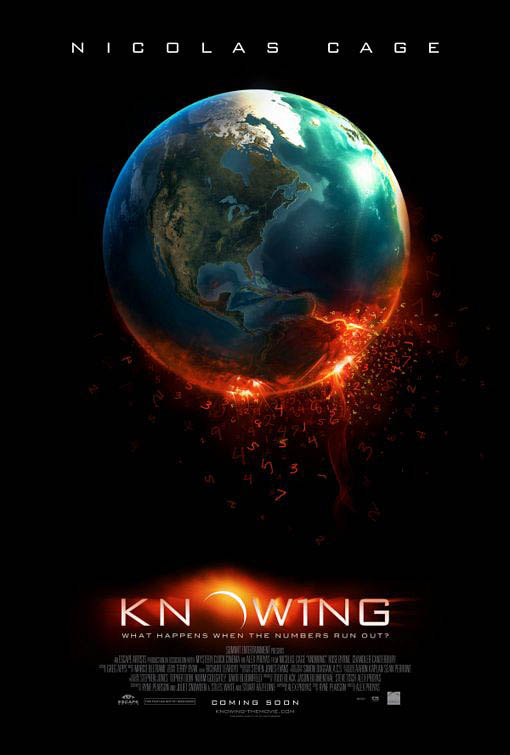
Forgetting "Knowing"

***FYI, mild spoilers in here because it was the only way I could talk about this film. Don't read if you don't want to know. I don't give away everything, but a few tidbits of info.***

Yesterday afternoon, I topped off my spring break with one more jaunt to the theater. This time it was to see last weekend's box office hit Knowing, which stars Nicolas Cage. Now, if you read this blog or know me in any capacity, you'll know that I have a hard time saying that I didn't like something. Usually, I find enough nuggets of goodness (parts that I liked) to more or less enjoy a film (or book or experience... etc.). Not so with this film. I'm not going to say I hated it - because that isn't strictly true. But I wasn't a huge fan.

Let me start by saying what I did like so I don't just rip it apart all at once. First of all, I really do adore Nicolas Cage. He can do no wrong in my eyes. His presence on the screen made the film more or less workable. Second, I applaud the writers for the basic premise of the film - the idea of a sheet filled with numbers coming out of a time capsule, and having these numbers spell out all the natural disasters, etc etc... That is cool. Also, I like some of the ideas presented in the film. The presentation of science versus religion, determinism versus randomness, of the inevitability of our planet's destruction... those are a good set of ideas to build a film around. Particularly the last one. We're so worried about mutual destruction through nuclear power, about global warming, starvation, and wars (all things we could more or less try to change) that we don't realize that a simple burst of energy from our sun - a bit of radiation - could wipe us out before you can say "uh oh." All I'm saying is that if the end is going to come - in that big cataclysmic sense - we're probably not going to be able to do much about it.

Okay, now onto what didn't quite work. My main problem with this movie is that it had no genre. I expected it to be in the sci fi action adventure realm - and those elements are there... but there's also the haunted house angle, coupled with an undertone of child-devil or the exorcist, mixed in with a religious allegory, layered right on top of a Close Encounters-esque alien invasion story line. What the hell kind of audience is this film going to appeal to? It's too scary for the soft-weight, nerdy, sci fi types... too outlandish for the hardcore horror fans... and there's too much fiction for the intellectual scientific types. No matter who sees this film, it seems to me that there is going to be an element that just doesn't quite fit.

Next: there was no character development, relationships, or emotional attachments for the audience to latch onto, for the story to be more real. The relationship between Cage's character and his son Caleb was painful to watch - laden down with horrible cliche lines like "Don't make me ask you twice, Caleb!" and "Do your homework, no TV tonight." Additionally, Cage's character was supposed to be a hurting widower, slowly becoming a drunk - but even though he was downing massive amount of whiskey, it really only resulted in a few extra naps. The characters were all the epitome of flat and static. Backstory came in little bursts, but nothing ever truly came of it. Last but not least, there was no romance between Cage and his female counterpart Rose Byrne. I'm not saying that every good film has to have a romance - but this movie could have used one to lighten it up, make it more poignant.

Let me just take a moment to go back to one of the things I've already said: I liked the premise of the story. This wasn't even a case of "good idea, bad execution" (like the so-so film Vantage Point, for example)... I just would have taken this good idea in a completely different direction, and I probably wouldn't have taken it in the end-of-the-world direction at all. Allow my imagination to run free for a moment...If this had been a film I was making, here's what I would have done. Keep the beginning the same all the way through when Nicolas Cage gets the sheet of numbers. Keep the woman who wrote the numbers alive and bring her back into the story somehow - not quite sure what I'd do there yet. Anyway, Cage's character figures out what the numbers mean - matches them up with history... but instead of seeing only 3 future dates, there are more. Maybe 10. He and his buddies at MIT start working with the numbers after the plane crash - when they start to believe him. They finally figure out a formula that makes sense - that generates the future numbers, etc. They start looking at the components of the formula, and maybe find that the time and scale of these disasters are directly proportional to negativity poured into the universe - people killed, corruption, human destruction, etc. Something to do with a natural balance of positive and negative energy. Kind of like positive and dark matter. Conservation of Energy or something like that. They figure out that there's a way to balance these things out, and though they're not able to stop all the bad things from happening, they lessen them. Nice happy ending where father realizes that the negative feelings over his wife's death has been hurting his son and he has to make up for it. Voila! Feel good film.

This is getting quite long so I'll be sure to wrap it up now. I want to stress that I didn't hate the film - it just wasn't quite "for me." Nicolas Cage was fun to watch for 2 hours and the CGI (particularly at the end) was kind of cool. It was an interesting mix of ideas and elements, and a good end-of-the-world film. You'd have to watch it to know your own opinion - others I've spoken with liked it, while some hated it. As a complex film, it's going to be very dependent on the person seeing it. But, hey, you can't have an ace in the hole with every film you see, right?


Sunday, January 18, 2009

Defiance: A Film of Contrasts

Yesterday afternoon, I had the pleasure of seeing a truly great film. Defiance was one of those movies you come across that has everything. It's based on a true story, deals with a tough subject, and tells the timeless tale of fighting all odds. It had emotions, heroism, and the harsh reality of truth and death. It's also one of those films that I knew I was going to like, I sat there watching it thinking "I really like this film," and I walk out of the theater thinking "Wow, that was a really great film." It's simply the kind of story that draws me in; and they would have really had to have done a horrible job of it to disappoint me.

Defiance tells the story of the Bielski brothers who lived in Belorussia during WW2. (Yes, another Nazi movie. What can I say, they're good - albeit hard to watch - films). After their family is murdered, the brothers (Tuvia, Zus, Asael, and Aron, by decreasing age) go to the forest that they know quite well to hide. Other persecuted Jews follow them, and they begin building what is essentially a colony, living and hiding in the forests. Tuvia becomes the leader, as Zus joins another group of Russian fighters, and they continue to move and survive. They defy odds, make it through winter and sickness, fight off the Germans, find love, disagree, join together, but most importantly, simply survive. By the end of the film, we are told they ultimately saved 1200 people, and that upwards of tens of thousands of individuals owe their lives to the brothers today.

As an action, defiance is not easy. It takes courage and resolve; you must fight the odds and fight to stay strong. As a film, Defiance was not easy to watch. It depicted the harsh truths of the Holocaust; the brutality of it all. It begins with stock footage of a village of Jews being raided by the SS policemen and soliders. Children are ripped screaming from their parents arms, and men are shot right and left for sport or trying to escape. But this is not R-rated brutality for the sake of it - it shows what it was like. As in any WW2-related film I've seen (the first I was was It's a Beautiful Life; the most recent was The Reader), I'm left questioning HOW could this have ever happened in our world.

So as a story, Defiance was truly remarkable. As the trailer says, it's a "story that's never been told," which surprises me, as it's a wonderful tale to tell. From that alone, the film had a strong foundation. I also liked the acting. Daniel Craig, of course, can do no wrong in my eyes. When I said I enjoyed Defiance yesterday, a friend mentioned to me that it was hard to imagine Bond as anything other than Bond, but that was the last thing from my mind. Sans the tuxedo and the I'm-better-than-everyone look, and with the ruggedness of war-time, grunginess of living in the forest, and a harsh Russian accent... I promise you, James Bond is nowhere to be scene. The film's other primary actors: Liev Schrieber, Jamie Bell, Alexa Davalos, etc were also worth of their roles. Each brought depth and energy to their characters.

From an analytical film perspective, I also found a lot to look at in this film. My experience with the director, Edward Zwick, lies in a similarly difficult film, Blood Diamond, which depicts the terrible atrocities occuring in Africa over the Diamond Trade. Zwick seems to have a real talent for taking a real-life tragedy, one that is hard to watch, yet riveting, and spinning a masterful web of emotions and strong characters.

But I was most struck by the use of contrasts in the film, and I found these contrasts everywhere. They were in the dialogue, as when Tuvia gives a rousing speech to the survivors in the forest, explaining that "If we must die trying to live, at least we will die as human beings." (paraphrased). Or when Lilka attempts to get him to allow a baby in the camp, pointing out the urgency of bringing life into the world when there is so much death. They were in the plot, as when the brothers go on a rampage of revenge shortly after their family was killed, threatening to become much like the Nazi's they were fighting. They were in the editing, the filmmaking, as when Asael's wedding was juxtaposed over Zus' first main military engagement after joining with the Russian fighters. The riveting horror and beauty of the wedding celebrations, then the fighting and shooting, then the wedding, back and forth, was powerful. They were even in the scenery, as the green of the forest was lost to the winter white, then melted through the yellow sunlight.

Defiance was a powerful film. One that I'd highly recommend.